The Daily Habits That Can Transform Your Health in 30 Days

Building a sustainable fitness routine isn’t about overhauling your entire life overnight. It’s about stacking small, repeatable actions that compound over time. The people who see lasting results aren’t necessarily working harder-they’re working more consistently.
Here are seven daily health habits that separate those who maintain progress from those who constantly restart.
Habit 01: Prioritize Protein at Every Meal
Protein isn’t just for post-workout shakes. It supports muscle retention, satiety, and metabolic function throughout the day. Most people underestimate how much they actually need — especially if they’re training regularly.
A practical target: aim for 1.6−2.2 grams of protein per kilogram of bodyweight daily, spread across meals.
The challenge? Real life.
There will be mornings when you skip breakfast or days when cooking isn’t possible. That’s where a fast, convenient option like ISO100 Hydrolyzed Whey Protein helps maintain consistency. Because it’s hydrolyzed, it absorbs quickly and fits seamlessly into smoothies, oats, or even just water, making it easier to stay on track without overthinking it.
Habit 02: Move Daily, Even on Rest Days
Training hard matters, but so does staying active on off days. Light movement walking, stretching, and cycling keep blood flowing, clear metabolic waste, and support faster recovery.
Think of it as active recovery rather than complete rest. Research suggests low-intensity movement helps muscles return to baseline more efficiently than staying sedentary.
Simple rule: if you’re not training, at least walk for 20 – 30 minutes.
Habit 03: Treat Recovery Like Training
Recovery isn’t passive; it’s where adaptation actually happens. Muscles don’t grow during workouts; they grow during rest, sleep, and proper nutrition afterward.
Key recovery priorities:
• Sleep: Aim for 7 – 9 hours. This is when growth hormone peaks and tissue repair accelerates.
• Post-workout nutrition: A combination of protein and carbohydrates within 30 – 60 minutes post-training supports glycogen replenishment and muscle protein synthesis.
• Hydration: Water is essential, but nutrient-rich options like milk or protein shakes offer additional recovery benefits.
If your schedule makes it difficult to prepare a full post-workout meal, keeping Elite 100% Whey Protein on hand provides a practical fallback. It delivers quality protein for sustained recovery without requiring kitchen time.
Habit 04: Hydrate Before You Feel Thirsty
Dehydration impairs performance, recovery, and cognitive function often before you even notice symptoms. Most people operate in a mild state of dehydration without realizing it.
Practical approach:
• Start your day with a full glass of water
• Keep a bottle visible throughout the day
• Increase intake around training sessions
Don’t rely on thirst alone. By the time you feel it, you’re already behind.
Habit 05: Eat Whole Foods First, Supplements Second
Supplements exist to fill gaps not replace meals. Whole foods provide fiber, micronutrients, and satiety that powders and pills can’t replicate.
Build your nutrition foundation on:
• Lean proteins (chicken, fish, eggs, legumes)
• Complex carbohydrates (oats, rice, potatoes)
• Healthy fats (nuts, avocado, olive oil)
• Vegetables and fruits for micronutrients
Once that foundation is solid, supplements become useful tools for convenience and consistency not crutches.
Habit 06: Track What Matters
What gets measured gets managed. You don’t need to obsess over every calorie, but having visibility into key metrics helps you course-correct before small issues become big problems.
Worth tracking:
• Weekly training volume
• Daily protein intake (even rough estimates help)
• Sleep quality and duration
• Bodyweight trends (weekly averages, not daily fluctuations)
Tracking doesn’t need to be complicated. A notes app or simple spreadsheet works fine.
Habit 07: Build Systems, Not Motivation
Motivation is unreliable. It comes and goes based on mood, energy, and circumstances. Systems repeatable routines that don’t require willpower are what sustain long-term progress.
Examples of systems:
• Laying out gym clothes the night before
• Prepping protein sources on Sundays
• Keeping a shaker bottle and protein powder at your desk
• Scheduling workouts like non-negotiable meetings
The goal is reducing friction. When healthy choices become the default, consistency stops feeling like effort.
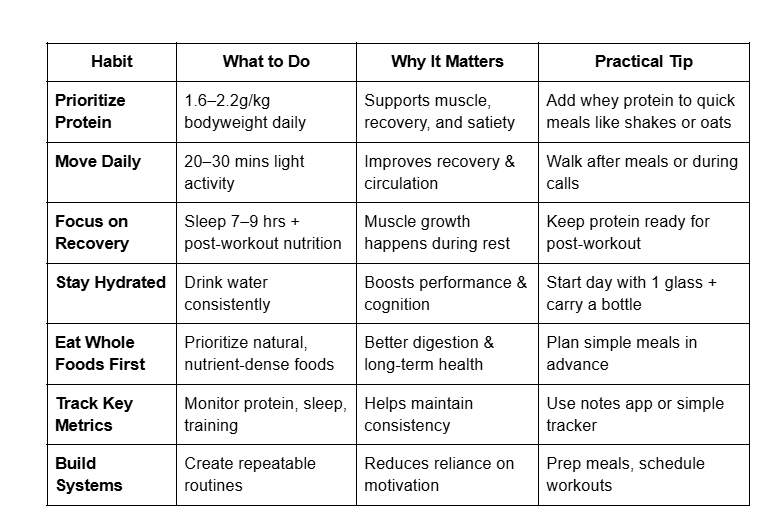
Quick Summary of Daily Health Habits
To make these habits easier to follow, here’s a quick breakdown you can refer to daily:
The Role of Protein in Daily Health Habits
Across most of these habits, protein plays a central role.
It supports:
muscle recovery
satiety
metabolic health
long-term consistency
Yet it’s also one of the most commonly missed targets.
For many active individuals, meeting daily protein needs through food alone isn’t always practical. That’s where high-quality options like ISO100 Hydrolyzed Whey Protein can help bridge the gap, especially when time, schedule, or appetite make full meals difficult.
The goal isn’t to rely on supplements; it’s to use them intelligently.
Final Thought: Consistency Compounds
None of these habits is revolutionary on its own. But stacked together and repeated daily, they create the conditions for meaningful, lasting progress.
Start with one or two. Once they feel automatic, add another. The goal isn’t perfection, it’s building a healthy lifestyle that doesn’t require constant willpower to maintain.
If hitting your daily protein consistently remains a challenge, exploring high-quality options like Dymatize protein powders can simplify the process — especially on days when time and energy are limited.
Small habits. Repeated daily. That’s how real results are built.


