The Truth About Carbs in Protein Powder: What You Really Need to Know

You pick up a tub of protein powder for one reason: protein. But flip to the nutrition label, and you’ll often find carbs sitting quietly in the mix, sometimes more than you’d expect. If you’re tracking macros, cutting, or just trying to keep your shake clean, those carbs matter more than most people realise.
The Indian Diet Is Already Carb-Heavy; Your Protein Powder Shouldn’t Add to That
Before you even open the shaker, think about what’s already on your plate. Rice, roti, dal, potatoes, sugar in your chai, a samosa at the office the average Indian diet leans carb-dominant by design, not by accident. It’s how most of us grew up eating, and it’s not a bad thing on its own.
The problem starts when your “protein” shake quietly stacks more carbs on top of all that. A scoop with 20 – 25g of hidden carbs isn’t a rounding error; when your day already runs carb-heavy, it’s compounding a macro imbalance you’re actively trying to fix by taking the shake in the first place. This matters even more given how common insulin resistance and blood sugar sensitivity are within Indian populations, so a shake that spikes sugar on top of a rice-and-roti day works against you twice over.
What Actually Happens When Your Protein Powder Is High in Carbs
It eats into your calorie budget without you noticing. A scoop that looks “just protein” can add 15 – 25g of hidden carbs. Stack that on a naturally carb-rich thali, and a cutting or lean-bulk plan takes a real hit.
It spikes blood sugar at the wrong time. Maltodextrin and dextrose-heavy blends digest fast, triggering an insulin spike on top of the one your last meal of rice or roti already caused.
It causes bloating and gut discomfort. Added sugars and lactose (common in cheaper concentrates) are frequent triggers for that heavy, gassy feeling post-shake the opposite of what a recovery drink should do.
It masks your actual protein efficiency. A “30g protein” label means little if you’re also swallowing 20g of carbs and 200+ calories you didn’t account for. You end up under-eating protein relative to your real calorie spend.
It makes tracking harder than it needs to be. If you’re counting macros seriously, every gram of surprise carbs is a gram you have to hunt down and correct for elsewhere in a day that’s already carb-loaded.
Enter Dymatize Elite 100% Whey
This is exactly the gap Elite 100% Whey is built to close, and it’s worth understanding why in more depth.
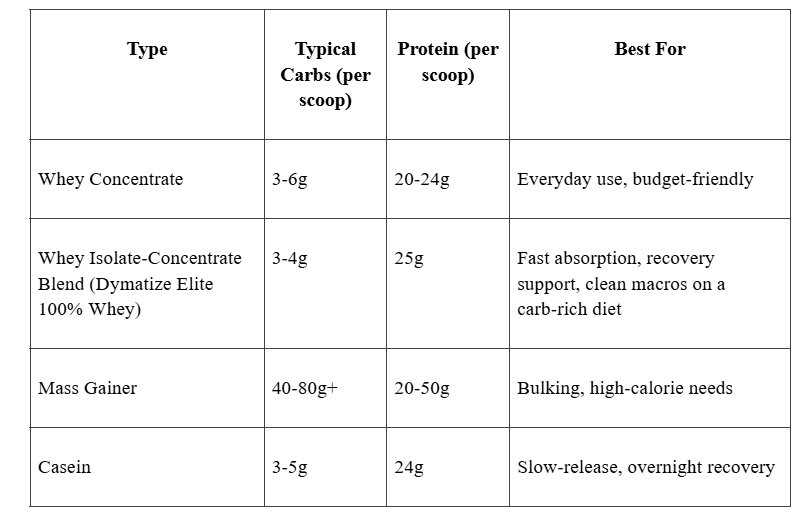
The formulation. Elite 100% Whey is built on a blend of whey protein isolate and whey protein concentrate, giving you 25g of fast-absorbing protein per scoop for around 140 calories, with total carbs landing at just 3 – 4g and 2g of sugar. It also carries 5.5g of BCAAs (2.7g leucine) and 4g of glutamine per serving, so you’re getting recovery support alongside the protein, not just a calorie-dense shake with a protein label on it.
Why that matters more on an Indian plate. Because your rice, roti, and chai are already doing the carb job, Elite 100% Whey lets your shake do the protein-and-recovery job instead, cleanly, without duplicating what your meals already gave you. It’s protein that fits into your existing diet instead of fighting it.
The digestion angle. Lactose intolerance is notably common in Indian populations, and it’s often what’s behind that bloated, uneasy feeling after a shake, not the protein itself. Elite 100% Whey is formulated to be fast-absorbing and easy on digestion, so it’s built to sit well even for people who’ve had trouble with heavier, concentrate-only blends in the past.
Where it fits in your day. Post-workout, pre-workout, or as an anytime high-protein drink, Elite 100% Whey is designed to slot in without adding meaningfully to a carb load you’ve likely already hit through your meals. It comes in flavours built for the Indian palate, so it doesn’t feel like a compromise either.
The takeaway: it’s not about cutting carbs out of your life — dal-chawal isn’t going anywhere. It’s about making sure the supplement meant to top up your protein and recovery actually does that job, instead of quietly adding to a carb load your diet has already covered.
Comparison Table: Carbs Across Protein Powder Types
FAQs
Are all protein powders high in carbs?
No. It varies a lot by type and formulation; some blends carry significantly more due to added carb sources and less filtration, while whey isolate-concentrate blends like Elite 100% Whey are formulated to keep carbs low while still delivering fast-absorbing protein.
Why do carbs in protein powder matter more on an Indian diet?
Because rice, roti, dal, and sugar-heavy tea or snacks already make up a large share of daily carb intake for most Indians. A protein powder with hidden carbs adds to a load that’s usually already met, rather than filling the protein gap it’s meant to.
How many carbs are “okay” in a protein powder?
Under 4 – 5g per scoop is generally considered low-carb for a whey product. Anything in the double digits usually means added sugars or carb-based fillers, not just naturally occurring trace carbs.
How many carbs does Dymatize Elite 100% Whey have?
Around 3 – 4g of total carbs and 2g of sugar per scoop, alongside 25g of protein, keeping it lean while still supporting recovery with BCAAs and glutamine.
Is a concentrate-isolate blend bad because of the carbs?
Not at all. Elite 100% Whey’s carb count is still low relative to most protein powders. The blend is chosen for fast absorption and recovery support, not to pad calories, and the carbs stay well within a lean daily target.
Can high-carb protein powders affect fat loss?
Yes, indirectly. The extra calories and possible blood sugar spikes can make it harder to stay in a deficit, especially when stacked on an already carb-rich daily diet.


