Morning V/s Evening Workout: Which is More Effective?

You’ve probably picked your workout time based on your calendar, not your biology. But your training time changes more than you’d think your body temperature, hormones, and even your sleep quality all shift across the day, and each one quietly decides how hard you can push, how well you recover and how your protein intake matters according to when you choose to train. Here’s what’s actually happening to your body at each hour, and why it matters for your results.
A Sneak Peak at What Exactly Happens at Each Hour.
Body temperature. Your core body temperature is at its lowest in the early morning and climbs steadily through the day, usually peaking in the late afternoon to early evening. A warmer core means looser joints, more pliable muscles, and faster nerve signaling which is why lifts often feel heavier and reps feel harder right after waking up, even if your effort hasn’t changed. It’s also why digestion tends to run slower first thing in the morning, since blood is still being redirected toward warming up muscles rather than your gut a fast-absorbing protein like Dymatize ISO100’s hydrolyzed whey isolate has less digestive work left to do, so it doesn’t fight that sluggish morning system.
Hormones. Testosterone and cortisol both peak in the morning, giving you an early surge of alertness and readiness to move. But that hormonal spike doesn’t automatically translate into better performance strength, power, and reaction time are driven more by temperature and neural readiness, both of which are still warming up early in the day. Cortisol is also catabolic, meaning it can pull amino acids from muscle tissue when none are readily available so getting fast-digesting protein early, right when cortisol is at its daily high, helps counter that before it works against your recovery.
Sleep quality. Training time also talks back to your sleep. A tough evening session raises core temperature and cortisol right when your body should be winding down, which can delay melatonin release and push back sleep onset. Morning and midday sessions, on the other hand, tend to support a more natural evening wind-down. Protein choice matters here too; a slow-digesting shake sitting heavy in your stomach late at night can add to that disruption, while a fast-absorbing option like hydrolyzed whey clears out of your system well before it’s time to sleep.
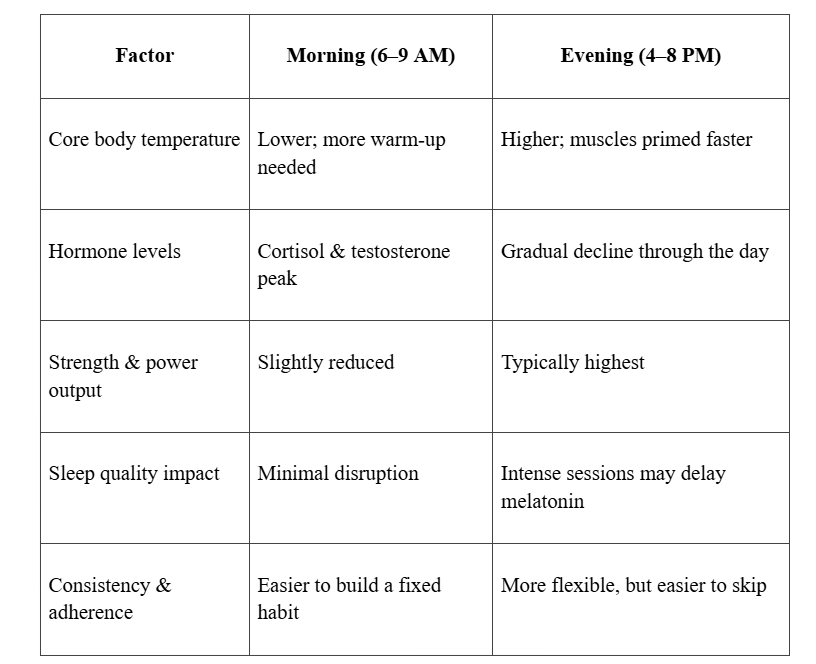
Neither slot is objectively “better”; your body adapts to whatever time you train consistently. What matters more is what you do around the workout, especially how you refuel.
Where Recovery Nutrition Comes In
Since digestion speed already plays into every training hour, your protein choice should keep up rather than add to the load. Dymatize ISO100 is built on hydrolyzed whey protein isolate, pre-broken into smaller peptides before you drink it, so amino acids reach your muscles sooner whether you’re training against a morning cortisol spike or racing the clock before bed.
With 25g of protein, 5.5g of BCAAs, and virtually no lactose, gluten, or added sugar per serving, ISO100 fits either training window without adding extra digestive load right when your body’s trying to recover.
So, Morning or Evening?
If pure performance is your priority, evening training has a slight biological edge. Your body is warmer, stronger, and more coordinated by then. If consistency or sleep protection matter more, morning holds its own. The real differentiator isn’t the clock, it’s whether you show up regularly and refuel with fast-absorbing protein afterward.
FAQs
Does training time really affect muscle growth?
Not by much over the long term. Studies show similar strength and muscle gains between consistent morning and evening trainees timing affects single-session performance more than long-term results.
Is evening protein intake bad for sleep?
No protein itself doesn’t disrupt sleep. It’s an intense evening exercise that can raise cortisol and delay melatonin, not your post-workout shake.
Why does hydrolyzed protein digest faster than regular whey?
Hydrolysis breaks whey protein isolate into smaller peptides before consumption, so your gut has less work to do, which speeds up absorption and reduces bloating for many people.
Can I drink ISO100 first thing in the morning?
Yes. Its fast-absorbing, easy-digesting profile makes it a good fit for a quick morning shake, not just post-workout recovery.
What if I switch between morning and evening workouts?
Your body adapts either way. Just prioritize a consistent recovery routine including quick, easy-to-digest protein regardless of what time you train.


